
FSH UIN Jakarta Promotes Financial Literacy and Sharia Investment through Capital Market School
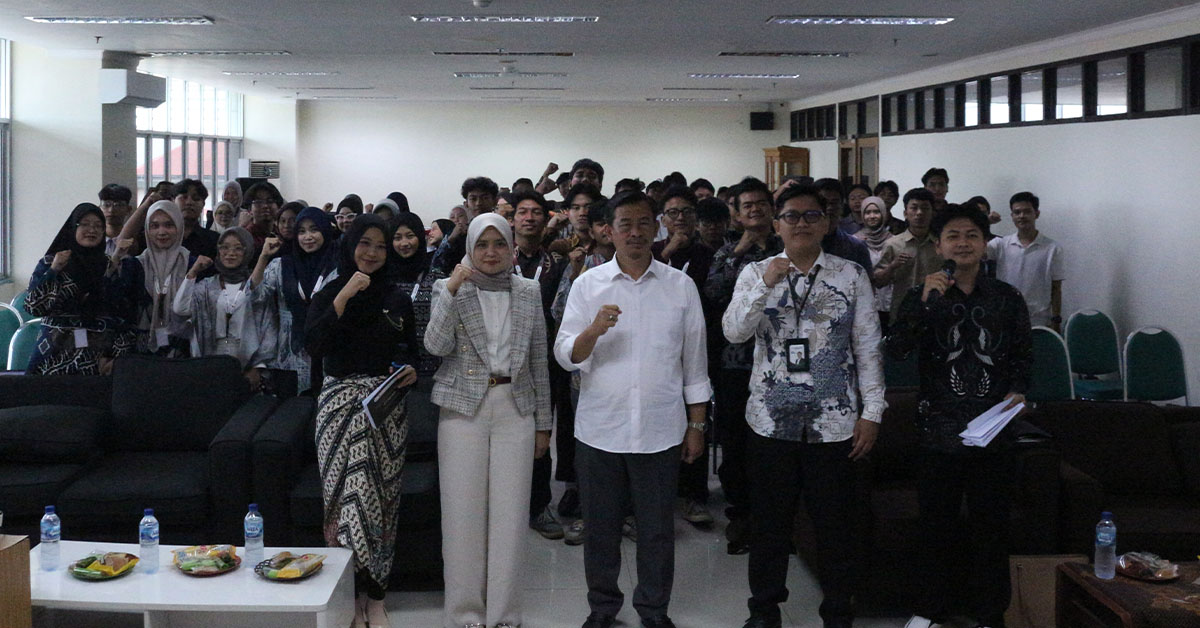
FSH NEWS, 7th Floor Auditorium, Central Library Building, UIN Syarif Hidayatullah Jakarta — The Faculty of Sharia and Law (FSH) at UIN Syarif Hidayatullah Jakarta is promoting greater financial literacy and investment awareness among students through a capital market education program featuring practitioners from the Financial Services Authority (OJK), the Indonesia Stock Exchange (IDX), and a securities company.
The program featured three speakers: Suwariyanti, Manager of Consumer Education, Financial Literacy, and Communication (PEPK & LMST) at OJK Banten; Muhammad Fadli Fatahuddin, Head of the IDX Banten Region; and M. Luth Sukma Jaya Putra, Representative of Korea Investment & Sekuritas Indonesia (KISI) Banten. The session was moderated by Hanan, a representative of the FSH UIN Syarif Hidayatullah Jakarta Investment Gallery (GIBEI).
The program began with a presentation by Suwariyanti on the role of OJK in supervising the financial services sector and protecting consumers. She explained that the financial services sector consists of three main areas: banking, capital markets, and non-bank financial industries.
In addition to learning about the role of financial regulators, participants were encouraged to develop sound and structured financial management habits. One of the concepts presented was the 40-30-20-10 financial allocation principle, covering basic consumption needs, financial obligations or installments, savings and investments, as well as social allocations such as zakat, infak, and sedekah.
Participants were also encouraged to distinguish between needs and wants and to develop the habit of setting aside part of their income for savings and investment from an early stage.
During the session, Suwariyanti also reminded participants to be cautious of illegal investment schemes and various forms of digital financial crime. One of the key principles emphasized was 2L: Legal and Logical. Every investment offer should be checked for its legal status and assessed rationally based on potential returns, risks, and the transparency of its business activities.
“Do not be easily tempted by high returns within a short period. Make sure the investment is legal and logical before placing your funds,” was one of the key messages delivered during the financial literacy session.
Understanding the Capital Market and Investment Instruments
In the second session, Muhammad Fadli Fatahuddin delivered the Level 1 Capital Market School session, introducing participants to the fundamentals of the capital market and various investment instruments.
He explained that the Indonesia Stock Exchange serves as an organizer and facilitator of securities trading to ensure that transactions are conducted in an orderly, fair, and efficient manner. The capital market serves as a platform connecting companies seeking long-term financing with members of the public who have funds available for investment.
Participants were introduced to various capital market instruments, including stocks, bonds, sukuk, mutual funds, and Exchange-Traded Funds (ETFs). Each instrument has different characteristics, potential returns, and risks. Investors therefore need to understand the instruments before making investment decisions.
The session also covered Indonesia’s capital market ecosystem, which involves the Self-Regulatory Organizations (SROs), namely the Indonesia Stock Exchange (IDX), the Indonesian Clearing and Guarantee Corporation (KPEI), and the Indonesian Central Securities Depository (KSEI). Participants also learned about investor protection mechanisms through the Investor Protection Fund.
Understanding Sharia-Compliant Investment
Meanwhile, M. Luth Sukma Jaya Putra provided a dedicated session on the Islamic capital market and the practical process of opening a sharia-compliant investment account.
He explained that the Islamic capital market is part of the broader capital market industry that applies sharia principles to its mechanisms and transactions. In practice, sharia-compliant investment avoids elements of riba, gharar, and maysir.
Participants were also introduced to the screening process for sharia-compliant stocks, which considers both a company’s business activities and financial conditions. To monitor the performance of sharia-compliant stocks, investors can refer to several indices, including the Indonesia Sharia Stock Index (ISSI), Jakarta Islamic Index (JII), JII 70, IDX-MES BUMN 17, and IDXSHAGROW.
Beyond conceptual understanding, the session also provided practical experience in opening a sharia investment account digitally through the iKISI application. Participants received guidance on data verification, the Sharia Customer Fund Account (RDN), and mechanisms for conducting stock transactions in accordance with sharia principles.
The program provided students with an opportunity to understand investment not only in terms of potential returns, but also from the perspectives of legality, risk, security, and compliance with sharia principles.
Through this initiative, FSH UIN Jakarta continues to encourage the development of students with strong financial literacy and the ability to make more informed and structured financial decisions. An understanding of financial planning, digital security, capital markets, and sharia-compliant investment is expected to provide students with valuable knowledge for navigating future economic and financial dynamics.
Ultimately, participants were encouraged to apply the “Legal and Logical” principle in every investment decision and to make use of official OJK channels when encountering indications of illegal investment schemes or digital financial crimes.